


Read Now
Business Analyst vs Data Analyst: What’s the Real Difference?
Confused between Business Analyst and Data Analyst roles?
This post breaks down the key differences in mindset, tools, and deliverables — so you can choose the path that fits you best.
Business Analyst vs Data Analyst: What’s the Real Difference?
When I first explored analytics, I was stuck at a fork:
Should I become a Business Analyst or a Data Analyst?
Spoiler: I became a Business Analyst — but not before digging deep to understand both paths.
If you’re confused between the two roles, don’t worry. Let me walk you through it from the perspective of someone who started in sales, transitioned to tech, and now works with both BAs and DAs at Swiggy.
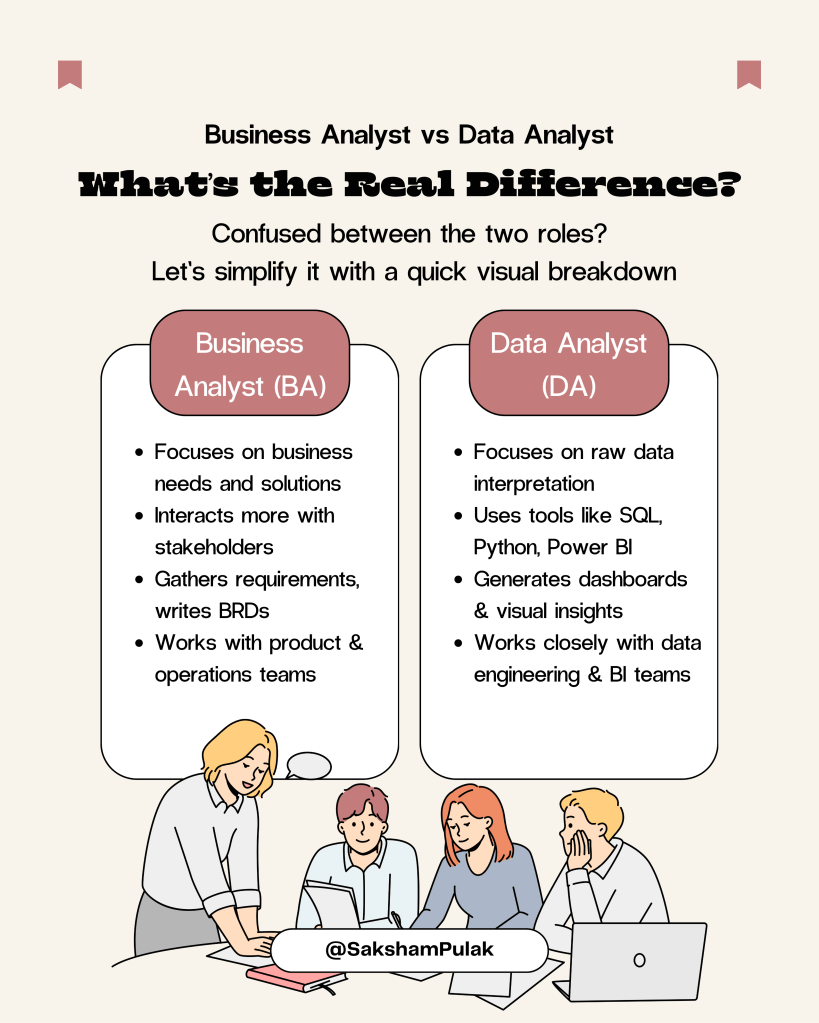
🎯 Core Focus & Role Goals
| Aspect | Business Analyst (BA) | Data Analyst (DA) |
|---|---|---|
| Purpose | Understand business needs and drive improvements | Analyze data to discover patterns and trends |
| Goal | Bridge the gap between business and tech | Extract actionable insights from raw data |
| Outcome | Improved processes, better product features, smoother operations | Data-driven decisions, predictive analysis, deep reporting |
🧠 Mindset & Thinking Approach
- BA: Business-first mindset “Why is delivery time increasing in North Zone and how can we optimize it?”
- DA: Data-first mindset “Let’s check if there’s a correlation between delivery delays and surge pricing.”
🛠️ Tools of the Trade
Business Analyst Tools:
- Excel (for documentation + basic analytics)
- Power BI / Looker Studio (for dashboards)
- Jira, Confluence (agile documentation)
- Flowcharts & BPM tools
- SQL (intermediate querying)
Data Analyst Tools:
- SQL (heavy usage)
- Python or R (data manipulation, stats)
- Excel (advanced formulas, pivoting)
- Tableau / Power BI (visualization)
- Google BigQuery / Snowflake / Data Studio
👥 Collaboration & Team Dynamics
- BAs collaborate with product managers, developers, QA, business teams, and sometimes customers.
- DAs collaborate with data engineers, analytics leads, and BI/reporting teams.
🔁 In many companies (like Swiggy), both roles are required on projects like:
- Gig worker efficiency dashboards
- Surge price analysis
- City-specific performance evaluation
📄 Deliverables Comparison
| Deliverables | Business Analyst | Data Analyst |
|---|---|---|
| BRDs & FRDs | ✅ | ❌ |
| User stories (Agile) | ✅ | ❌ |
| Business process models | ✅ | ❌ |
| Dashboards & Reports | 🔄 | ✅ |
| Data cleaning/preprocessing | ❌ | ✅ |
| Statistical analysis | ❌ | ✅ |
| Insight storytelling | ✅ | ✅ |
🔄 = May contribute
🚀 Career Entry: Skills You Need
To be a Business Analyst:
- Strong communication & stakeholder management
- Basic understanding of data
- Problem-solving mindset
- Documentation & process mapping skills
- Tools: Excel, Jira, Power BI, SQL
To be a Data Analyst:
- Solid data querying and manipulation skills
- Comfort with statistics & analytics
- Scripting (Python/R) optional but helpful
- Strong visualization skills
- Tools: SQL, Excel, Tableau, Power BI, Python
🧩 Real-World Example from My Work
Let’s say we’re analyzing why delivery satisfaction dropped in Tier-2 cities.
- The DA will pull user review data, average delivery time, order patterns, and cancellation metrics — identifying a drop after 8 PM orders.
- The BA will coordinate with the operations team, discover a gig worker shortage during late hours, and propose increasing pods or incentives during that window.
Both play vital roles — one in finding the “why”, the other in fixing the “what.”
🧠 Which One Is Right for You?
Choose Business Analyst if:
- You enjoy working with people and improving systems
- You’re a storyteller who translates needs into solutions
- You like structure, documentation, and collaboration
Choose Data Analyst if:
- You love numbers and patterns
- You enjoy diving into datasets and uncovering insights
- You prefer working more independently on deep analysis
Bonus: Some professionals combine both skills over time and grow into hybrid roles or product analysts!
💬 My Journey
From sales at upGrad to my first analytics project at GlobalLogic, and now business dashboards at Swiggy — I’ve often worked shoulder-to-shoulder with DAs.
The magic happens when both roles sync — insight meets implementation.
💡 Final Thought:
It’s not BA vs DA — it’s BA x DA.
Both are essential. Your choice depends on your strengths and interests.
📌 Next Up (Day 7): What I Do Daily as a Business Analyst (Real-Life Workflow)
📣
Thinking about entering analytics? Which path are you leaning toward — Business Analyst or Data Analyst? Or a mix of both? Let’s chat in the comments!
🔖
#BusinessAnalyst, #DataAnalyst, #CareerSwitch, #AnalyticsWithSakshamPulak, #BAvsDA, #SakshamPulak, #BusinessAnalysis, #DataAnalytics, #CareerPaths, #DailyLearning


Leave a comment